Tiberius
1.
An emperor of Rome from A.D. 14 to 37. His full name was Tiberius
Claudius Nero Caesar. He was the son of T. Claudius Nero and of Livia, and was born on
the 16th of November, B.C. 42, before his mother married Augustus. Tiberius was tall and
strongly made, and his health was good. His face was handsome, and his eyes large. He was
carefully educated, and became well acquainted with Greek and Latin literature, his master in
rhetoric being Theodorus of Gadara. Though not without military courage, as his life shows,
he had a great timidity of character, and was of a jealous and suspicious temper; and these
qualities rendered him cruel after he had acquired power. There can be little doubt that his
morose reserve and his dissimulation had been increased, if not created, by his relations to
Augustus. As emperor the difficulties of his position, and the influence of Livia and still
more of Seianus, increased his tendency to jealousy and suspicion of all who seemed rivals or
dangerous from their popularity. The system of espionage and delation (see
Delatores) once begun could only increase with each
act of tyranny and cruelty, till his rule became a veritable reign of terror. Yet in reading
his history, especially the tales of his monstrous and incredible licentiousness, it must be
recollected that Tacitus and Suetonius both wrote with a strong bias against him and his
rule, and were ready to accept as true the worst scandals which were handed down. If Velleius
was prejudiced in the other direction, it is at least right to adopt some part of his less
unfavourable portrait and to imagine that the old age of Tiberius was not so absolutely
contradictory of his youth as it is sometimes made to appear. The cruelty of his rule applied
only to Rome. The testimony of Iosephus and Philo shows that his provincial government was
just and lenient.
In B.C. 11, Augustus compelled Tiberius, much against his will, to divorce his wife,
Vipsania Agrippina, and to marry Iulia, the widow of Agrippa, and daughter of the emperor,
with whom Tiberius, however, did not long live in harmony. Tiberius was thus brought
into still closer contact with the imperial family; but as Gaius and Lucius Caesar, the
grandsons of Augustus, were still living, the prospect of Tiberius succeeding to the imperial
power seemed very remote. He was employed on various military services. In 20, he was sent by
Augustus to restore Tigranes to the throne of Armenia. It was during this campaign that
Horace addressed one of his epistles to Iulius Florus (i. 12), who was serving under
Tiberius. In 15, Drusus and his brother Tiberius were engaged in warfare with the Raeti, and
the exploits of the two brothers were sung by Horace (
Carm. iv. 4, 14). In 13, Tiberius was consul with P. Quintilius
Varus. In 11, while his brother Drusus was fighting against the Germans, Tiberius conducted
the war against the Dalmatians and against the Pannonians. Drusus died in 9, owing to a fall
from his horse. On the news of the accident, Tiberius was sent by Augustus to Drusus, whom he
found just alive. Tiberius returned to the war in Germany, and crossed the Rhine. In 7 he was
consul a second time. In 6 he obtained the
tribunicia potestas for five
years, but during this year he retired with the emperor's permission to Rhodes, where he
spent the next seven years. Tacitus says that his chief reason for leaving Rome was to get
away from his wife, who treated him with contempt, and whose licentious life was no secret to
her husband; probably, too, he was unwilling to stay at Rome when the grandsons of Augustus
were attaining years of maturity, for there was mutual jealousy between them and Tiberius. He
returned to Rome A.D. 2. He was relieved from one trouble during his absence, for his wife
Iulia had been banished to the island of
 |
|
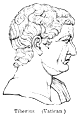
Tiberius. (Vatican.)
|
Pandataria (B.C. 2), and he never saw her again. (See
Iulia.) After the deaths of L. Caesar (A.D. 2) and C. Caesar (A.D. 4),
Augustus adopted Tiberius, with the view of leaving to him the imperial power; and at the
same time he required Tiberius to adopt Germanicus, the son of his brother Drusus, though
Tiberius had a son Drusus by his wife Vipsania. From the year of his adoption to the death of
Augustus, Tiberius was in command of the Roman armies, though he visited Rome several times.
He was sent into Germany A.D. 4. He reduced all Illyricum to subjection A.D. 9; and in A.D.
12 he had the honour of a triumph at Rome for his German and Dalmatian victories.
On the death of Augustus at Nola, on the 19th of August, A.D. 14, Tiberius, who was on his
way to Illyricum, was immediately summoned home by his mother, Livia. He assumed the imperial
power without any opposition, affecting all the while a great reluctance. He began his reign
by putting to death Postumus Agrippa, the surviving grandson of Augustus, and he alleged that
it was done pursuant to the command of the late emperor. When he felt himself sure in his
place, he began to strengthen the principate. He took from the popular
assembly the election of the magistrates, and transferred it to the Senate. The news of the
death of Augustus roused a mutiny among the legions in Pannonia, which was quelled by Drusus,
the son of Tiberius. The armies on the Rhine under Germanicus showed a disposition to reject
Tiberius, and if Germanicus had been inclined to try the fortune of a campaign, he might have
had the assistance of the German armies against his uncle. But Germanicus restored discipline
to the army by his firmness, and maintained his fidelity to the new emperor. The first year
of his reign was marked by the death of Iulia, whom Augustus had removed from Pandataria to
Rhegium. The death of Germanicus in the East, in A.D. 19, relieved Tiberius from all fear of
a rival claimant to the throne; and it was believed by many that Germanicus had been poisoned
by order of Tiberius. (See
Germanicus.)
From this time Tiberius began to indulge with less restraint in his love of tyranny, and many
distinguished senators were soon put to death on the charge of treason against the emperor
(
laesa maiestas). Notwithstanding his suspicious nature, Tiberius gave
his complete confidence to Seianus, who for many years possessed the real government of the
State. This ambitious man aimed at the imperial power. In 23, Drusus, the son of Tiberius,
was poisoned by the contrivance of Seianus. Three years afterwards (A.D. 26) Tiberius left
Rome, and withdrew into Campania. He never returned to the city. He left on the pretext of
dedicating temples in Campania, but the real cause was probably his dislike to Rome, where he
knew that he was unpopular; and Seianus was only too anxious to encourage any feeling which
would keep the emperor at a distance from the city. That Tiberius went because he wished to
hide his licentiousness in this place of retirement may be set down as a silly invention, for
Rome was not a place where licentiousness was hated. He took up his residence (A.D. 27) in
the island of Capreae, at a short distance from the Campanian coast. The death of Livia (A.D.
29), the emperor's mother, released Tiberius from one cause of anxiety. He had long been
tired of her, because she wished to exercise authority, and one object in leaving Rome was to
be out of her way. Livia's death gave Seianus and Tiberius free scope, for Tiberius never
entirely released himself from a kind of subjection to his mother, and Seianus did not
venture to attempt the overthrow of Livia's influence. The destruction of Agrippina and her
children was now the chief purpose of Seianus; but he finally got from Tiberius (A.D. 31) the
reward that was his just desert, an ignominious death. (See
Seianus.) The death of Seianus was followed by the execution of his
friends; and for the remainder of the reign of Tiberius, Rome continued to be the scene of
tragic occurrences. Tiberius died on the 16th of March, 37, at the villa of Lucullus, in
Misenum. He was seventy-eight years of age, and had reigned twenty-two years. He was
succeeded by Gaius (Caligula), the son of Germanicus, but, according to Tacitus, he had
himself appointed no successor (
Tac. Ann. vi.
46), though he had appointed Gaius the heir of his private property (
Suet. Tib. 76) in conjunction with Tiberius
Gemellus, whom Gaius afterwards put to death. On the other hand, Iosephus has a story of
Tiberius committing the Empire to Gaius (
Ant. xviii. 6, 9). Tiberius did not die a natural death. It was
known that his end was rapidly approaching, and having had a fainting-fit, he was supposed to
be dead. Thereupon Gaius came forth and was saluted as emperor; but he was alarmed by the
intelligence that Tiberius had recovered and called for something to eat. Gaius was so
frightened that he did not know what to do; but Macro, the prefect of the Praetorians, with
more presence of mind, gave orders that a quantity of clothes should be thrown on Tiberius,
and that he should be left alone (
Tac. Ann. v.
50; Dio Cass. lviii. 28). Suetonius mentions a suspicion that Tiberius was poisoned at
the last by Gaius (
Suet. Tib. 73;
Suet. Cal. 12). Tiberius wrote a brief commentary of
his own life, the only book that the emperor Domitian studied (
Suet.
Tib. 67;
Suet. Dom.
20), and also Greek poems, and a lyric poem on the death of L. Caesar (
Suet. Tib. 70). Tiberius, both as a ruler and as a
man, has not lacked defenders in modern times, among them Dean Merivale in his
Romans under the Empire (1865);
Beesly, Catiline,
Clodius, and Tiberius (1878); and Baring-Gould,
The Tragedy of the
Caesars, vol. i.
(1892). For the adverse view see
Boissier,
L'Opposition sous les Césars (1875). For the general
history of his reign see Pasch,
Zur Kritik der Geschichte des Kaisers
Tiberius (Altenburg, 1866); Stahr,
Tiberius (Berlin,
1873); H. Schiller,
Geschichte der römischen Kaiserzeit
(Gotha, 1883); and Freytag,
Tiberius und Tacitus (Berlin,
1870). See also the essay prefixed to Furneaux's
Annales, vol. i.
(1884).
2.
Tiberius Gemellus, son of Drusus junior (
Drusus, No. 5), twin with another son, who died early. He was therefore
grandson of Tiberius and regarded as a dangerous rival by Caligula, who put him to death soon
after his accession (
Suet. Tib. 54;
Suet. Cal. 14Suet. Cal.
23). It is said that Tiberius doubted his legitimacy. This and his youth may have been
reasons against his being named successor to the Empire (
Suet.
Tib. 62;
Tac. Ann. vi.
46).
3.
A philosopher and sophist, of unknown time, the author of numerous works on grammar and
rhetoric. One of his works, on the figures in the orations of Demosthenes (
Περὶ τῶν παρὰ Δημοσθένει Σχημάτων), is still extant. It is
edited by Spengel
(1856).


